
Updated 01 June 2026
 |
|---|
The influence of the Angkorean civilization is woven into all aspects of Cambodia life in ways that are unique worldwide both in the depth and breadth of its impact. For those longer-term visitors to Siem Reap, they have the great fortune to have the time and means to explore it in more depth than the quick skim of the great monuments allowed by the standard two-day tour enjoyed by 90% of tourists.
The Rise of the Angkorian Civilisation
Few archaeological landscapes in the world rival the scale, complexity and enduring mystery of Angkor Archaeological Park. Spread across more than 400 square kilometres of forest, reservoirs, canals and temple cities, Angkor was once the heart of the Khmer Empire, one of the most powerful civilisations in pre-modern Asia.
The Angkorian period is generally dated from 802 CE, when King Jayavarman II declared himself a universal monarch or “chakravartin”, until the gradual decline of Angkor during the 14th and 15th centuries. At its peak, the empire controlled large parts of present-day Cambodia, Thailand, Laos and Vietnam, while maintaining trade links with India and China.
Yet despite decades of research, archaeologists still debate many fundamental questions surrounding Angkor. Unlike Rome or China’s imperial capitals, the Khmer Empire left relatively few written records. Much of what is known comes from inscriptions carved into stone, Chinese diplomatic accounts and the architecture itself.
One of the greatest revelations of recent decades has been the discovery that Angkor was not simply a collection of temples, but a vast low-density urban complex. Lidar laser scanning conducted by international research teams revealed hidden roads, canals, suburbs and water systems beneath the forest canopy, suggesting that Angkor may once have supported close to a million inhabitants.
The civilisation’s engineering capabilities remain one of archaeology’s great puzzles. Millions of sandstone blocks were quarried, transported and assembled with extraordinary precision despite the absence of iron cranes, mortar or modern machinery. Researchers still debate exactly how the Khmer moved these stones over such distances.
The decline of Angkor also remains contested. Earlier theories blamed invasion by the Siamese kingdom of Ayutthaya, but modern scholarship increasingly points to a combination of climate instability, water management failure, political fragmentation and shifting maritime trade routes. Evidence suggests prolonged droughts followed by catastrophic monsoon flooding may have damaged the hydraulic systems on which the city depended.
Major Temples and Their Historical Roles
 |
|---|
Angkor Wat Temple
The best-known structure remains Angkor Wat itself, constructed during the reign of King Suryavarman II in the early 12th century.
Unlike most Khmer temples, Angkor Wat faces west rather than east, leading some scholars to suggest funerary symbolism. Originally dedicated to the Hindu god Vishnu, the temple later became an important Buddhist site and remains one today.
 |
|---|
The temple is designed as a symbolic representation of Mount Meru, the cosmic mountain at the centre of Hindu and Buddhist cosmology. The five towers represent Meru’s peaks, while the surrounding moat symbolises the cosmic ocean.
Less widely appreciated is the extraordinary astronomical precision embedded within the temple. Researchers have identified alignments linked to equinoxes and solar movements, suggesting advanced astronomical knowledge.
The bas-reliefs of Angkor Wat also function as historical archives. They depict mythological scenes such as the Churning of the Ocean of Milk alongside military processions and royal imagery that provide insights into Khmer society, warfare and religion.
 |
|---|
Bayon
Located at the centre of Angkor Thom, Bayon was built by Jayavarman VII in the late 12th century and represents the transition toward Mahayana Buddhist state ideology.
Its most famous features are the giant smiling stone faces. Scholars still debate whom they represent. Possibilities include the bodhisattva Avalokiteshvara, the king himself or a fusion of divine and royal identity.
The bas-reliefs at Bayon are particularly valuable because they portray ordinary life as well as warfare. Scenes include markets, cockfighting, childbirth, fishing and Chinese merchants.
Ta Prohm
Ta Prohm is famous for the giant strangler fig and silk-cotton trees growing through its structures. Built by Jayavarman VII as a Buddhist monastery and university, it was intentionally left partially unrestored by French conservators to illustrate how the jungle reclaims abandoned monuments.
Inscriptions suggest Ta Prohm once supported thousands of priests, dancers and workers, highlighting the immense administrative machinery behind Angkorian religion.
Banteay Srei
Often described as the “Citadel of Women”, Banteay Srei is celebrated for some of the finest stone carving in Southeast Asia.
Constructed from pink sandstone rather than grey sandstone, its miniature scale contrasts sharply with the grand imperial temples. The extraordinary detail of the carvings has survived remarkably well because of the stone’s hardness.
Preah Khan
Less famous among short-term tourists but highly valued by residents, Preah Khan was both monastery and administrative centre. It once housed scholars and officials while serving as a ceremonial city.
The temple’s labyrinthine design and partially forested sections provide one of the richest experiences for repeat visitors.
Neak Pean
Built on an artificial island in a reservoir, Neak Pean reflects Khmer interest in sacred healing and cosmology. Its pools may have been associated with ritual purification.
East Mebon and Pre Rup
These temple mountains reveal how Angkor’s sacred architecture evolved before Angkor Wat. East Mebon originally stood on an island in the now-dry East Baray reservoir.
Pre Rup is particularly popular at sunset and may have had funerary significance.
Lesser-Known Historic Sites
Long-term residents often find the quieter and less-visited temples more compelling than the iconic monuments.
Beng Mealea
 |  |
|---|
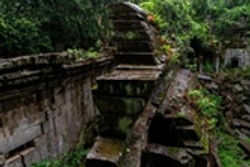
Located east of the main park, Beng Mealea remains partially collapsed and heavily overgrown. Its atmosphere resembles what early European explorers encountered.
Kbal Spean
Known as the “River of a Thousand Lingas”, Kbal Spean contains carvings in the riverbed itself. The site combines archaeology with jungle hiking and waterfalls.
Koh Ker
Once a rival capital to Angkor, Koh Ker features a dramatic pyramid temple unlike anything else in Khmer architecture.
Banteay Ampil and Prasat Chrung
These smaller and quieter sites are ideal for residents seeking solitude, photography or cycling routes away from tourist crowds.
The Mystery of the Barays
Among Angkor’s most astonishing achievements are the giant reservoirs known as barays.
The West Baray alone measures roughly eight kilometres long and more than two kilometres wide. These structures required extraordinary labour coordination and hydraulic engineering.
Scholars continue debating their exact functions. Earlier theories viewed them mainly as irrigation systems supporting rice agriculture. Modern researchers believe they also had symbolic and political significance, representing cosmic oceans around Mount Meru while reinforcing royal authority through control of water.
Recent climate research suggests Angkor’s sophisticated hydraulic network may have initially helped the empire survive monsoon variability but later became vulnerable to severe climatic shifts.
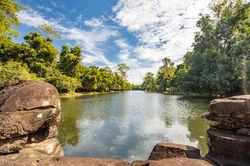
Today the West Baray remains in active use. Residents swim, fish and picnic there, while local farmers still benefit from associated water systems. The reservoir has effectively become both ancient monument and living landscape.
The small island temple of West Mebon, accessible only intermittently depending on water levels and restoration work, remains one of Angkor’s more enigmatic sites.
 |
|---|
Hinduism, Buddhism and Temple Symbolism
Angkor’s temples reflect centuries of religious transition between Hinduism and Buddhism.
Early Khmer rulers primarily followed Hindu traditions centred on Shiva and Vishnu. Later kings, especially Jayavarman VII, promoted Mahayana Buddhism, before Theravada Buddhism eventually became dominant.
This religious evolution explains why many temples contain overlapping iconography. Buddha statues were sometimes added to Hindu sanctuaries, while earlier carvings were modified or destroyed during later ideological shifts.
Apsaras and Devatas
 |
|---|
 |
|---|
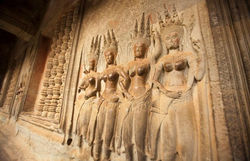
The graceful female figures carved across Angkor are among its defining artistic features.
Apsaras are celestial dancers from Hindu mythology, while devatas are guardian deities. Researchers have identified thousands of individually distinct carvings throughout Angkor.
Modern Cambodian classical dance draws heavily from these temple carvings, particularly hand gestures and costumes.
Construction Techniques
The temples were built primarily from sandstone blocks laid without mortar. Precise fitting and concealed joints provided structural stability.
Many scholars believe canals were used to float stone blocks from quarries at Phnom Kulen. Evidence also suggests extensive use of wooden scaffolding and ramps, although few direct traces survive.
The Archaeological Park
 |
|---|
APSARA National Authority manages the archaeological park in cooperation with UNESCO and multiple international conservation teams.
The park was designated a UNESCO World Heritage Site in 1992 after years of conflict and looting during Cambodia’s civil war period.
The archaeological zone includes not only temples but also forests, villages, reservoirs, canals and agricultural landscapes.
Several international bodies operate conservation and research programmes, including:
-
École française d'Extrême-Orient
-
Archaeological Survey of India
-
German Apsara Conservation Project
-
Japanese Government Team for Safeguarding Angkor
These groups focus on structural restoration, stone conservation, mapping, drainage systems and archaeological excavation.
Lidar mapping projects involving Australian and international universities have transformed understanding of Angkor’s urban scale over the past decade.
The Annual Resident Pass
Long-term foreign residents can obtain an annual Angkor pass at significantly reduced cost compared with tourist pricing.
Applicants generally need:
-
A valid long-term Cambodian visa or work permit
-
Proof of residence in Cambodia
-
Passport identification
The pass allows repeated entry to the archaeological park throughout the year and is especially valuable for photographers, cyclists, runners and residents who prefer exploring lesser-known temples gradually.
For many residents, the pass changes the experience of Angkor entirely. Instead of rushing through temples in several days, they can explore slowly over months and seasons, observing changing light, weather and vegetation.
Foreign Participation in Archaeology
Direct participation in excavations is generally limited because most digs require professional archaeological qualifications and government permits.
However, there are still ways for residents to engage with Angkorian research. Several conservation bodies offer public lectures, heritage workshops and educational events. Residents occasionally participate in volunteer heritage documentation, photography and conservation awareness programmes.
Academic institutions periodically recruit specialists in archaeology, GIS mapping, conservation science and heritage tourism.
The Angkor Centre for Conservation of Biodiversity also offers opportunities linked to environmental preservation around archaeological zones.
Events and Activities in the Park
The archaeological park increasingly functions as both heritage site and community space.
The annual Angkor Empire Marathon attracts international runners and includes multiple race categories through temple landscapes. Cycling races and mountain bike events are also regularly organised.
Khmer New Year celebrations often involve cultural performances around Angkor, while traditional ceremonies continue at active Buddhist temples within the park.
 |
|---|
Photography workshops, astronomy gatherings and heritage walks are increasingly popular among long-term residents.
Several residents’ groups also organise dawn meditation sessions, birdwatching excursions and historical talks inside quieter sections of the park.