
Updated 16 Jul 2026
Since the opening of Siem Reap Angkor International Airport, known by the airport code SAI, the city has been developing a larger and more modern aviation service, with its international connectivity focused mainly on nearby Asian hubs rather than long-haul routes.
 |
|---|
Air Destinations
For long-term residents, this means Siem Reap is convenient for regional travel, visa runs, business trips and onward connections, but most journeys to Europe, North America or Australasia still require a change in Bangkok, Singapore, Kuala Lumpur, Ho Chi Minh City, Hanoi or Phnom Penh.
Main International Airlines
The main international airlines currently serving Siem Reap include Air Cambodia, Bangkok Airways, Thai AirAsia, Thai Airways, Vietnam Airlines, VietJet, Singapore Airlines, Malaysia Airlines or Firefly-linked services, China Eastern, Emirates, IndiGo, Lao Airlines and Mahogany Air.
Current scheduled destinations include Bangkok Suvarnabhumi, Bangkok Don Mueang, Ho Chi Minh City, Hanoi, Da Nang, Singapore, Kuala Lumpur, Kunming, Kolkata and, seasonally or on limited schedules, Luang Prabang and Phuket. Domestic Cambodian links to Phnom Penh and Sihanoukville are also useful for onward international travel.
Typical same-day flight schedules show Singapore Airlines departing Siem Reap around 16:00 and arriving in Singapore at about 19:25.
Thai AirAsia operates to Bangkok Don Mueang and Kuala Lumpur, with an example departure around 16:55 and arrival around 18:05. Vietnam Airlines and Air Cambodia operate Siem Reap–Ho Chi Minh City services, with example departures around 18:30 or 19:10 and arrivals around 19:50 or 20:25. Vietnam Airlines also operates to Hanoi, with an example departure around 18:55 and arrival around 20:40. Bangkok Airways has an evening Siem Reap–Bangkok Suvarnabhumi flight, with an example departure around 19:35 and arrival around 21:05. Inbound examples include Hanoi–Siem Reap at around 16:20–18:00, Ho Chi Minh City–Siem Reap at around 17:15–18:20 or 17:35–18:40, Bangkok Suvarnabhumi–Siem Reap at around 17:35–18:55, and Da Nang–Siem Reap at around 16:35–18:40. These times should be treated as indicative rather than permanent, as seasonal tourism flows can change frequencies quickly.
For the broadest choice of onward connections, Bangkok and Kuala Lumpurare usually the most flexible options. Suvarnabhumi is better for long-haul and full-service carriers, while Don Mueang is useful for low-cost flights within Thailand and the region. Kuala Lumpur International Airport, the hub for Air Asia, is also a good option for budget travel. Singapore is the strongest premium hub, particularly for Australia, Europe and intercontinental connections. Kuala Lumpur is generally attractive for budget flights, while Ho Chi Minh City and Hanoi are useful for Vietnam travel and connections into North Asia. Kolkata is a newer and more limited direct link but may be useful for India-bound travellers.
Road Travel
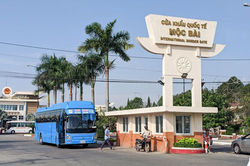
Despite the recent closure of the border with Thailand, road travel remains an option for travel to and from Vietnam. For Vietnam, the usual overland journey is Siem Reap to Ho Chi Minh City, often via Phnom Penh and the Bavet–Moc Bai border crossing. Direct or semi-direct bus services are available, but journeys are long, normally around 12 to 14 hours. Current online prices are typically in the US$40–55 range, depending on the operator, seat type and booking platform. Vireak Buntham is one of the operators associated with Cambodia–Vietnam routes, while other companies may offer minivan and coach combinations.
 |
|---|
The route is practical for budget travellers but can be tiring, and the Phnom Penh transfer can add uncertainty. For residents carrying luggage or travelling with family, flying to Ho Chi Minh City is usually more comfortable.
Rail Options
Cambodia’s operating rail network links Phnom Penh with Sihanoukville in the south and Poipet on the Thai border in the north, via Battambang and Sisophon, but there is no active passenger rail line directly serving Siem Reap. Long-discussed rail projects connecting Siem Reap with Phnom Penh, the airport and Thailand remain development proposals rather than reliable everyday options.
Travellers who want a rail experience can travel by road from Siem Reap to Battambang, then connect with rail services where available, but this is not usually the simplest way to reach Bangkok.
Ferries
Ferry links from Siem Reap to foreign destinations are also limited. The historic boat service across Tonle Sap between Siem Reap and Phnom Penh or Battambang has been used by travellers in the past, but schedules are seasonal, water-level dependent and far less reliable than road travel. There is no practical international ferry from Siem Reap to Thailand or Vietnam. Those interested in river travel to Vietnam normally need to start from Phnom Penh or Chau Doc-related Mekong routes, rather than Siem Reap.
Getting to and from the airport
Access between downtown Siem Reap and SAI airport is one of the main practical issues for residents and visitors. The new airport is much farther from town than the old airport, with the journey typically taking around 45 minutes to 75 minutes depending on traffic, weather and final destination. For most passengers, the easiest option is a pre-booked private car through a hotel, travel agent, ride service or airport transfer desk. Prices commonly start from about US$30–35 for a standard car carrying one to three passengers, with larger vans costing more. This is the most convenient choice for early morning departures, late arrivals, heavy luggage or families.
The airport shuttle bus is the best budget option. Services are generally advertised at about US$8 one way, or around US$15 return where return tickets are offered. The bus usually takes about an hour and runs between the airport and central Siem Reap pick-up points. It is comfortable enough for most travellers, but passengers should check the current schedule in advance, especially for late-night or early-morning flights. For international departures, it remains sensible to arrive at the airport around three hours before flight time, particularly during peak tourism periods or when travelling with checked baggage.
Tuk-tuks are widely used within Siem Reap, but the airport distance makes them less attractive than in the days of the old airport. Some drivers will make the journey, and prices may be lower than a car, but the ride can be long, exposed to dust or rain, and uncomfortable with luggage.
For downtown trips, PassApp-style app bookings or agreed cash fares are common. For airport transfers, negotiation should be clear before departure: confirm whether the price is in US dollars or Cambodian riel, whether tolls or waiting time are included, and whether the fare is per vehicle rather than per person.
Local price negotiation is normal but should be kept polite. In town, short tuk-tuk journeys may be only a few dollars, while longer waits, temple trips or airport work cost substantially more. Drivers often quote high at first, particularly in tourist areas, but aggressive haggling over small sums is not well regarded. For regular residents, building a relationship with one or two reliable drivers is often better than bargaining from scratch every time. Tipping is not compulsory in Cambodia but rounding up or adding US$1–3 for good service, luggage help, late-night pick-ups or patient waiting is appreciated.
In terms of safety and reliability, flying remains the best choice for regional business travel and for time-sensitive journeys. Road travel to Thailand and Vietnam is affordable and useful, but border delays, vehicle comfort, night driving standards and operator quality vary. Residents should use established companies, avoid very cheap unknown night vans, keep valuables with them, and allow generous margins before onward flights. For those living long term in Siem Reap, the practical rule is simple: use the airport for speed and certainty, use buses for budget regional trips, and treat rail or ferry travel as occasional adventure rather than core transport infrastructure.